
We help you find Clients, Partners, Resellers, Distributors.
This article describes the differences between America and the Netherlands
https://aboutthenetherlands.com/dutch-culture-vs-american-culture-how-do-they-differ/
Administrative law is called “bestuursrecht”. There are framework laws called “kaderwetten” and specific laws. More explainatioin can be found here https://nl.wikipedia.org/wiki/Bestuursrecht_(Nederland)
Here is a search page through all laws. https://wetten.overheid.nl/zoeken
The chapter “How to select the right industry” contains a link to industry specific laws.
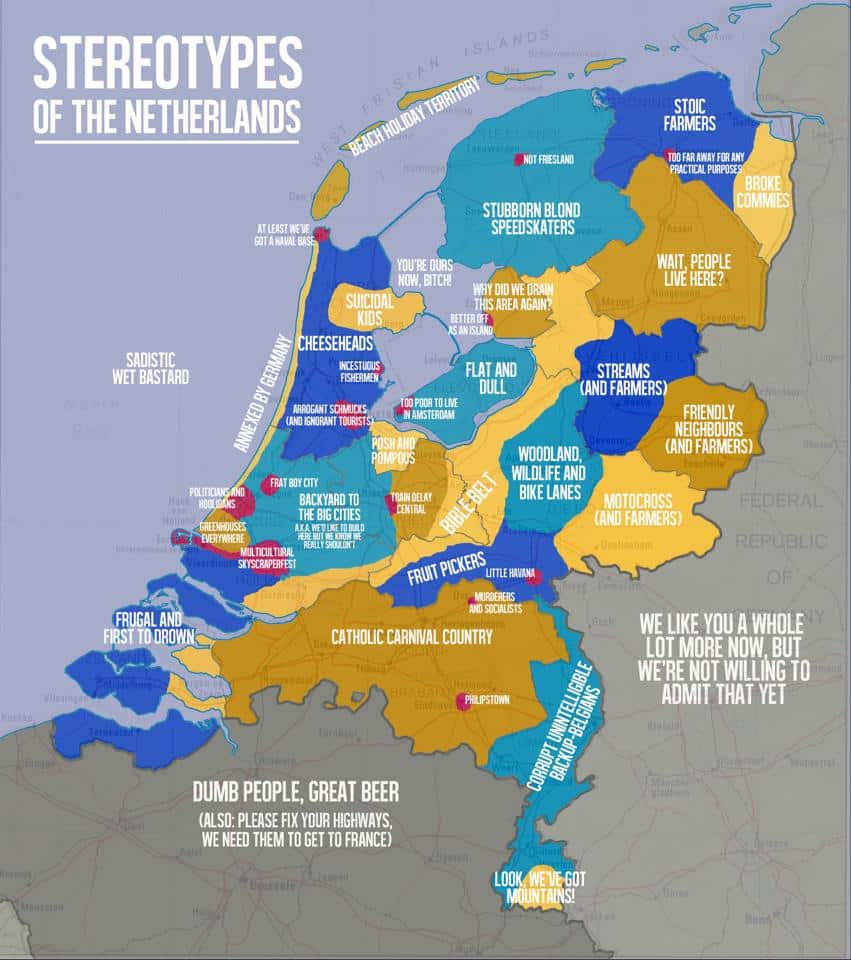
The Roman empire stopped at the river Rijn. Therefor the southern part is more Catholic and celebrates Carnaval. The Northern provinces Groningen and Friesland are known to be a bit more stubborn. The west is called “de Randstad” and is between Amsterdam, Rotterdam, Utrecht, Amersfoort. The people living there believe that this is where it all happens. The eastern part is considered farmers area. As a result, the southern part tends to be a bit more Belgian. The eastern part more German (Not that Germans are all farmers). Amsterdam is more like New York and in the North are the Viking. What is left is the Middle. An area which used to be the South Sea. Having said that, the difference is not that big.
The Netherlands scores low on this dimension (score of 38) which means that the following characterises the Dutch style: Being independent, hierarchy for convenience only, equal rights, superiors accessible, coaching leader, management facilitates and empowers. Power is decentralized and managers count on the experience of their team members. Employees expect to be consulted. Control is disliked and attitude towards managers are informal and on first name basis. Communication is direct and participative.
The Netherlands, with the very high score of 80 is an Individualist society. This means there is a high preference for a loosely-knit social framework in which individuals are expected to take care of themselves and their immediate families only. In Individualist societies offence causes guilt and a loss of self-esteem, the employer/employee relationship is a contract based on mutual advantage, hiring and promotion decisions are supposed to be based on merit only, management is the management of individuals.
The Netherlands scores 14 on this dimension and is therefore a Feminine society. In Feminine countries it is important to keep the life/work balance and you make sure that all are included. An effective manager is supportive to his/her people, and decision making is achieved through involvement. Managers strive for consensus and people value equality, solidarity and quality in their working lives. Conflicts are resolved by compromise and negotiation and Dutch are known for their long discussions until consensus has been reached.
The Netherlands scores 53 on this dimension and thus exhibits a slight preference for avoiding uncertainty. Countries exhibiting high Uncertainty Avoidance maintain rigid codes of belief and behaviour and are intolerant of unorthodox behaviour and ideas. In these cultures there is an emotional need for rules (even if the rules never seem to work) time is money, people have an inner urge to be busy and work hard, precision and punctuality are the norm, innovation may be resisted, security is an important element in individual motivation.
The Netherlands receives a high score of 67 in this dimension, which means that it has a pragmatic nature. In societies with a pragmatic orientation, people believe that truth depends very much on the situation, context and time. They show an ability to easily adapt traditions to changed conditions, a strong propensity to save and invest, thriftiness and perseverance in achieving results.
With a high score of 68, the culture of the Netherlands is clearly one of Indulgence. People in societies classified by a high score in Indulgence generally exhibit a willingness to realise their impulses and desires with regard to enjoying life and having fun. They possess a positive attitude and have a tendency towards optimism. In addition, they place a higher degree of importance on leisure time, act as they please and spend money as they wish.
Research has been done among European countries and their level of English when this is not the native tong. The Netherlands came out first. (Source: https://www.ef.nl/epi/) In the Netherlands movies are broadcasted with subtitles. That helps. Having said that, the lower the level of education to lower the level of English. When your software aims at lower level of education workers then the software needs to be in Dutch.
German is spoken by 71% of the population of the Netherlands and is the second most spoken foreign language, after English. It is taught at Dutch secondary schools and commonly spoken in the border areas, especially since citizens of both countries frequently cross the border to work or shop.
Information about the level of German can be found here: https://doublespeakdojo.com/how-common-is-spoken-german-in-the-netherlands-explained/